Services-as-software and outcome-based pricing
What is services-as-software?
Services-as-software is work you used to buy as a service, meaning an hour of somebody's attention, sold to you by the finished result instead. You do not licence a helpdesk tool and staff it, you pay a fixed amount for every conversation the vendor's agent finishes. You do not hire someone to chase disputed card payments, you pay a share of what comes back.
The vocabulary comes from the investors behind the first wave of these companies. Foundation Capital wrote the argument up in late 2024: the prize is not the software market but the roughly 4.6 trillion dollars companies spend on salaries and outsourced services, and any service that follows a repeatable process can be sold as an output instead of as effort.
The move is older than the vocabulary. A collection agency has always taken a percentage of what it recovers and a recruiter has always been paid on placement. What is new is that software does the work, in categories you were used to buying as seats: support, bookkeeping entry, first-line IT, contract review, lead qualification.
The pricing shapes, and what each one counts
The pitches sound alike and the units are not. Prices below are from the vendors' own pages on 4 September 2026, in US dollars.
Per resolved conversation. Fin, Intercom's support agent, charges 0.99 dollars per outcome, and its help centre splits that into a confirmed resolution, where the customer says the answer helped, an assumed resolution, where the customer leaves without asking again, and a Procedure handoff, where Fin completes a flow you configured that ends with a person. Zendesk puts 1.50 dollars on an automated resolution, which it describes as a conversation handled by an AI agent with no human intervention and confirmed by a 72 hour quiet period. It does not bill conversations that escalate to a colleague. HubSpot announced a move to 0.50 dollars per resolved conversation for its customer agent in April 2026, though it no longer publishes that rate. Three vendors, three claims that all read as "you pay when it works", three different definitions: under one a handoff to a person is billable, under another it is explicitly free.
Per recovered amount. Chargeflow bills 25 percent of every chargeback it wins back for a merchant and nothing until the money is actually recovered. This is the easiest outcome to price, because it is a bank transaction that either happened or did not.
Per processed document or per qualified lead. A processed document is an output, not an outcome: the vendor is paid whether or not the extraction was right. It becomes an outcome only when a correctness bar is attached.
Per outcome with a performance clause. Deloitte published a note in June 2026 on booking revenue from these contracts, listing tiered payment that varies with the success rate, a fixed fee with refunds below a threshold, and prepaid credits consumed only on completion. It also tells vendors to set "clear, objective, and measurable criteria" for success before they can recognise the revenue, which is worth knowing while you ask them to write that definition down for you.
Per-seat versus per-outcome: who carries the risk when the work is hard
With a seat licence you carry all of it. A password reset and a three-week dispute cost the same in software and wildly different in staff time, and the vendor is paid identically either way. Difficulty is your problem and it never shows up in the commercial relationship.
With a per-outcome price the vendor carries part of it, and manages that exposure in three ways. It prices a margin for the cases it handles badly into the unit rate, which is why the number looks high next to a raw model call. It scopes: these intents, these document types, this language, and anything outside comes back to you. And it writes the definition of done so that it stays cheap to measure, which is where the inactivity windows come from. A customer who was helped and a customer who gave up both go quiet, and after 72 hours they look identical to any counting rule.
The pattern was documented long before anyone sold an AI agent. The UK National Audit Office reviewed payment-by-results schemes covering at least 15 billion pounds of public spending in June 2015 and found that a poorly designed scheme creates perverse incentives that push providers towards the people who are easier to help. Read "cases" for "people" and you have the failure mode of every outcome contract. Under a seat price you absorb difficulty silently, under an outcome price difficulty becomes something the two of you negotiate in writing.
A worked example, and the price where the answer flips
A webshop handles 1,200 customer conversations a month. One takes a colleague about 8 minutes and loaded staff cost is 40 dollars an hour, so 5.33 dollars of someone's time per conversation.
The seat route. Three colleagues on a helpdesk with an AI copilot, at Intercom's Expert price of 132 dollars per seat, is 396 dollars of software. The copilot drafts replies and brings handling down to 6 minutes, so 1,200 conversations cost 120 hours, or 4,800 dollars of staff time. Total 5,196 dollars a month, about 4.33 per conversation.
The outcome route. Fin at 0.99 dollars finishes 55 percent of them, so 660 outcomes cost 653 dollars. The other 540 still need people at the full 8 minutes, which is 72 hours or 2,880 dollars, and two seats instead of three is 264 dollars. Total 3,797 dollars a month, about 3.16 per conversation.
Solve for the flip. The outcome route costs 660 times the unit price plus 3,144 dollars of staff and seats, so it matches 5,196 dollars when the unit price hits 3.11. Every published rate in this market, from 0.50 to 1.50 dollars per resolution, sits well under that. Even if only 8 of every 10 billed resolutions were genuine, the effective price per finished conversation is 1.24 dollars. More than two thirds would have to be false before the seat route wins on cost, so the definition of a resolution does not decide whether the deal is cheap. It decides what you are getting and whether the invoice is checkable.
The answer flips fast the other way as soon as the work carries judgement. Take a vendor quoting 60 dollars per reviewed contract where your own lawyer spends 45 minutes on one at 120 dollars an hour, so 90 dollars. That reads as a saving until you notice the lawyer reads all of them anyway, at which point you paid 60 dollars for a first draft and saved twenty minutes.
What to nail down before you sign
The unit, with its edge cases. Is a handoff billed, an abandoned chat, a case reopened on day four? Ask for it in a sentence you could read out to your bookkeeper.
Who judges quality, on what evidence. A monthly sample your side reads, a threshold, and a route for when the two counts disagree. Without that clause, quality is measured by whoever sends the invoice.
What happens to the cases the system cannot handle. Who does them, at what cost, and a floor under the scope so it cannot be narrowed after the first hard month.
The data you get back per case. What the agent did, what was billed and why, exportable in a format you can total up yourself against your own system.
What leaves with the vendor. The procedures, prompts, labelled examples and knowledge base edits are your process knowledge. If they live only in the vendor's console, switching costs you the capability, not a licence.
A committed volume and a ceiling. Ask what a committed volume costs against buying outcomes as you go, and put a monthly ceiling in the contract so a busy week does not arrive as a surprise.
Where this genuinely works, and where it does not
It works when the volume is high, the cases look like each other, and the outcome can be checked by a machine in a system you own. Money landing in the bank account, an invoice matched to a purchase order and paid, a password reset that held. There you can audit every line of the invoice without a meeting.
It works badly when the outcome is a judgement. A good contract review, a qualified lead, a correct reading of a complicated claim: someone has to decide, and if the vendor decides, you are buying their opinion of their own work. Deloitte's phrase, clear and objective and measurable, is the test.
There is an honest note under a lot of judgement-heavy outcome pricing: a person in the vendor's operation is doing the work. That is a perfectly good service and may well be cheaper than doing it yourself, but it is not what a claim about software doing the job implies, and it is close to what agent washing means. Ask what happens if your volume triples next month. A software answer and a staffing answer sound nothing alike.
What it changes on your side
A seat licence is an IT line, a price per resolved case is a cost of service and belongs next to the staff cost of the same work, so the process owner ends up signing for it rather than IT. And once you pay per outcome the vendor's dashboard is the invoice, so you need a count out of your own system and a monthly reconciliation of the two.
Your team's numbers change as well, and someone should say so before the first quarterly review. If the agent finishes the easy 55 percent, your automation rate looks good and everything left is harder per case, so average handling time rises and first-contact resolution falls. Neither is a performance problem, they are what remains once the simple work has left the queue.
On the labour question, stay with what companies actually reported. Klarna said in February 2024 that its AI assistant had handled 2.3 million conversations in its first month, two thirds of its customer service chats, doing the work of 700 full-time agents, with resolution time down from 11 minutes to under 2. In May 2025 its chief executive told Bloomberg that cost had become too dominant a factor, that the result was lower quality, and that the company was hiring people back for the conversations that needed them. Same company, same deployment, about a year apart. Outcome pricing does not settle how much of the work moves to software, it settles who is out of pocket when a case turns out to be hard.
Keywords
services-as-software
outcome-based pricing
per-resolution pricing
ai agent
consumption-based ai billing
automation rate
forward deployed engineer
ai-native enterprise
agent washing
pilot purgatory
digital labour
ai
From the blog.
More pieces from the field on the same topic.
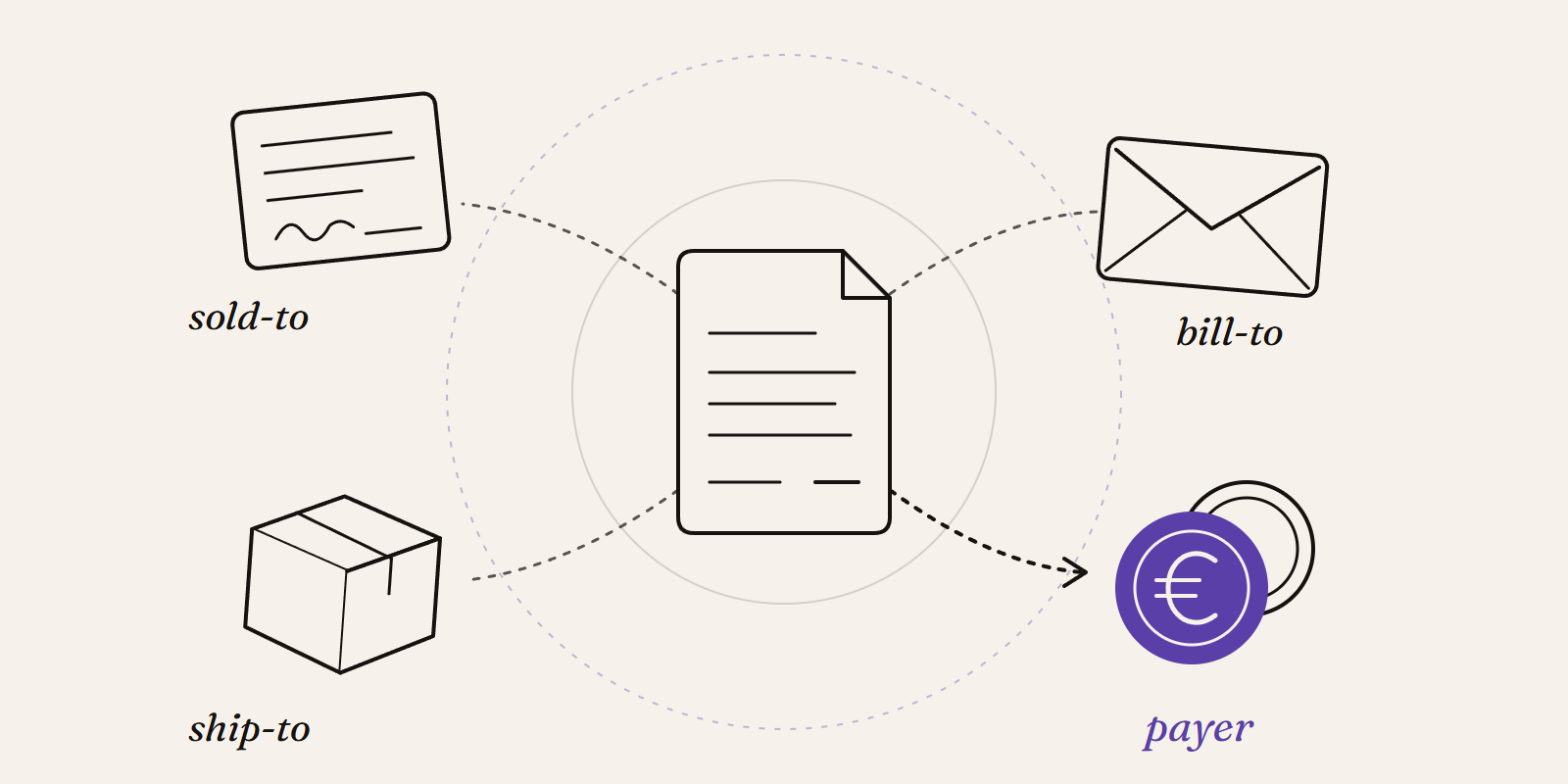
Sold-to, ship-to, bill-to and payer in SAP: who is actually your customer?
Sold-to, ship-to, bill-to and payer in SAP explained with a concrete example: who gets the invoice, whose account the receivable sits on, an...
New Data Panda connectors in August 2026
Seven new Data Panda connectors from August 2026: ECB rates, ProfitPlus Webshop, SAP S/4HANA, Exact Venice, OpusFlow, ABAX and Sprout Social...