Invoice automation (accounts payable)
What is invoice automation in accounts payable?
Invoice automation is everything between a supplier invoice arriving and the money leaving, done by systems wherever a system can do it. Accounts payable is the buying side of the ledger, so the work is receiving, checking, coding, approving, booking, paying and keeping the document. A person still owns the process. The point is that they spend their time on the invoices that need a decision instead of on the four hundred that do not.
E-invoicing is about the form the document arrives in, and your accounting package is only where the booking lands. Invoice automation is the layer in between, and that is where the hours sit. It is the project most small companies start with, because the volume is steady and the bookkeeper can already tell you how many minutes each invoice takes.
The pipeline from mailbox to payment
Draw the whole route before you automate any of it. Most projects come unstuck on the last four steps rather than on the reading.
Capture from the Peppol network, a shared mailbox, a supplier portal you have to log into, and occasionally paper. The portal is the channel people forget until somebody finds an unpaid invoice from six weeks ago.
Classification. Invoice, credit note, statement, reminder or delivery note? Multi-page PDFs holding several invoices get split here.
Extraction of invoice number, dates, supplier VAT number, IBAN, net, VAT per rate, total and lines. On a structured e-invoice there is nothing to extract.
Supplier identification on the VAT or enterprise number, not on the name, because the name arrives in four spellings and two legal forms.
Arithmetic and VAT validation. Do the lines add up to the net, does the VAT per rate match its base, does net plus VAT equal the total?
Matching against a purchase order where one exists, against a contract or price list where one does not.
Coding: the general ledger account and the cost centre.
Approval routing. The document, the order and the reason a person is needed, in one screen, in front of whoever holds the budget.
Booking into the accounting package, with a link back to the original document.
Payment proposal. Approved invoices grouped by due date, discount terms applied, released by a person.
Archiving. Belgian invoices have to be kept ten years counted from 1 January of the year after they were issued, up from seven since 2023.
The matching step deserves a paragraph of its own. A three-way match compares three documents that should tell the same story: the purchase order says what you agreed to buy and at what price, the goods receipt says what arrived, the invoice says what you are asked to pay. Quantity and price have to line up across all three within a tolerance you set, usually a few percent or a few euro, whichever is larger. Where nothing physical arrives, a service or a subscription, you fall back to a two-way match. In many Belgian SMEs there is no purchase order at all, and that is the single biggest thing standing between such a company and a high automation rate.
What Belgium's e-invoicing rules change
Since 1 January 2026 all Belgian VAT-liable companies have to send and receive structured electronic invoices for their domestic B2B transactions. The federal e-invoicing portal is precise about it: such an invoice is drawn up, sent and received in a structured electronic form that allows automatic processing, complying with the European standards EN 16931-1 and CEN/TS 16931-2. You have to be able to produce it in the Peppol BIS format and to send and receive it over the Peppol network, and you may only deviate when both parties agree and the alternative meets the same standard.
Not everyone is in scope. Outside it are businesses that carry out only transactions exempted under article 44 of the VAT Code, taxable persons not established in Belgium even with a Belgian VAT number, bankrupt taxable persons, flat-rate taxable persons under article 56 (a scheme expiring by 1 January 2028 at the latest), the small-business exemption scheme up to 25,000 euro turnover, and the special agricultural scheme. Invoicing to consumers is untouched, and a PDF counts as an ordinary electronic invoice rather than a structured one, so for Belgian domestic B2B it no longer does the job. From 1 January 2028 Belgium adds near real-time e-reporting, with VAT data going to the FPS Finance shortly after an invoice is issued or received, so ask any platform you are shortlisting how it intends to handle that.
An e-invoice against a PDF
Put the two side by side on one dimension: does anything have to be read at all? A Peppol BIS invoice is XML in which every value carries its own name. The invoice number is in the field called the invoice number, and the VAT rate sits next to the amount it applies to. Nothing is read and nothing is guessed, so there is no confidence score and no field-level threshold, because there is no model in the path. What can still go wrong is business logic: the supplier's product code is not your product code, or the order reference is missing.
A PDF is a picture of an invoice, or at best a text layer with coordinates. OCR turns the page into text, and a document model decides what that text means, the pair of steps usually sold together as Intelligent Document Processing. Something has to decide which of the four amounts on the page is the total, and that something is a model with a confidence score attached. So you get a review screen, thresholds per field, and a quiet failure mode nobody plans for: the supplier redesigns their template and last month's accuracy stops holding.
Every supplier that switches to Peppol deletes a piece of your extraction problem and none of your matching, coding or approval problem. That is worth saying to anyone who reads the mandate as a solution to their accounts payable work.
What decides your touchless rate
Four things, and the quality of the extraction model is not among them.
Supplier master data. Every supplier needs a VAT or enterprise number, a verified IBAN, payment terms, and a default general ledger account and cost centre. That last pair is what makes coding automatic: a telecom bill lands on the same account every month, so the system should propose it and not ask.
Whether purchase orders exist. With an order and a goods receipt, an invoice can be checked against something. Without them, somebody has to remember what was agreed. Introducing purchase orders for one category, say goods for resale, often moves the rate more than switching extraction engines does.
How many suppliers send structured e-invoices. Since the mandate this climbs on its own, but check whether the ones already on Peppol are sending you a PDF out of habit.
The layout variety of what is left. Twenty suppliers with stable templates is a tractable problem. Two hundred suppliers who each send three invoices a year is not, and it never becomes one.
Which points at how to scope the work. Sort last year's invoice count per supplier: in most SMEs, twenty to thirty suppliers account for half the volume. Automate those first, all the way through to booking, and leave the long tail on the manual path. The tempting mistake is to start with the supplier whose invoices are the biggest headache, because that is the pain everyone can name. That supplier is usually the hardest to automate and the smallest slice of the volume.
A worked example
A Belgian wholesaler receives about 500 supplier invoices a month. Before any automation, the bookkeeper opens the mail, saves the PDF, types the header fields into the accounting package, looks up the supplier, picks the account and the cost centre, mails it to the manager who owns that budget, waits, books it and files the PDF. Call it six minutes each, so 50 hours a month, plus 80 invoices that need a query to a colleague or the supplier at about a quarter of an hour, so 20 hours more. Around 70 hours a month, with an invoice sitting about twelve days between arriving and being booked, almost all of it waiting on an approval.
Afterwards, 200 of the 500 arrive over Peppol and 300 still arrive as PDFs. Of the e-invoices, 170 book untouched and 30 need a coding decision or hit a difference against the order, two minutes each. Of the PDFs, 160 come through clean, 70 need a correction on the review screen at three minutes, and 70 turn into a real business exception, a price that does not match or a delivery nobody can confirm, at twelve minutes each. That is roughly 1,110 minutes, so a bit under 19 hours a month, and time from arrival to booking drops to around three days because the approval happens on a phone instead of in an inbox.
At a loaded 40 euro an hour, a rounded working assumption, 70 hours is about 2,800 euro a month, around 5.60 euro an invoice in labour alone. After: 19 hours is about 760 euro, plus say 340 euro for the platform and the access point, so around 2.20 euro. The interesting part is not the ratio. It is that 70 of the 500 invoices now take up more than half of the remaining time, and those 70 are the next round of work.
What to measure
Touchless rate. The share of invoices reaching a booking with nobody in the finance team keying, correcting or chasing anything. Write down whether a budget holder clicking approve counts as a touch, because two companies quoting a touchless rate are usually counting different things. In the example above it is 330 out of 500, or 66 percent, with approvals left out. It is the accounts payable name for straight-through processing.
Cost per invoice. Loaded staff time plus software plus the access point, divided by the volume, recomputed every quarter rather than taken from the business case.
Days from arrival to booking. This tells you about your approval flow, not your software. If it does not move, the approvals are the bottleneck.
Exception reasons, ranked. The most useful report in the whole setup. Every invoice that leaves the automated path gets a reason code, and once a month you read the top three. Usually one is fixable at the source: one supplier billing the wrong entity, one product with a stale price, one buyer who never raises a purchase order.
Ardent Partners, in its 2025 Accounts Payable Metrics that Matter research, puts the average touchless rate around 33 percent and the top group around 49 percent. Those figures come mostly from large organisations with thousands of suppliers, so a small Belgian company with a narrow supplier list can beat them without having done anything clever.
What to watch out for with invoice automation
Approval is not an extraction problem. A budget holder looks at an invoice because somebody has to accept the spend, and no confidence score speaks to that. Set the approval thresholds on amount, cost centre and supplier risk, in the process where the finance manager can see and change them, not inside a model configuration.
Treat a new supplier and a changed bank account as fraud controls. The classic invoice fraud is a convincing invoice from a real supplier with a different IBAN on it. Make the rule absolute: a supplier IBAN is never updated from a document. It is updated by a named person after a call to a number you already had on file, and the change is logged. A first invoice from a supplier nobody has heard of goes to a human for the same reason.
A rising touchless rate with more corrections afterwards is not progress. If loosening a threshold pushes the rate up and the bookkeeper starts fixing bookings a week later, you moved the work rather than removed it. Track corrections made after booking alongside the rate, and keep the original file next to each entry, because a field with no link back to its document is hard to defend during an audit that can reach back ten years.
Keywords
invoice automation
accounts payable
ap automation
e-invoicing
peppol
three-way match
intelligent document processing
ocr
straight-through processing
exception handling
master data management
automation
From the blog.
More pieces from the field on the same topic.
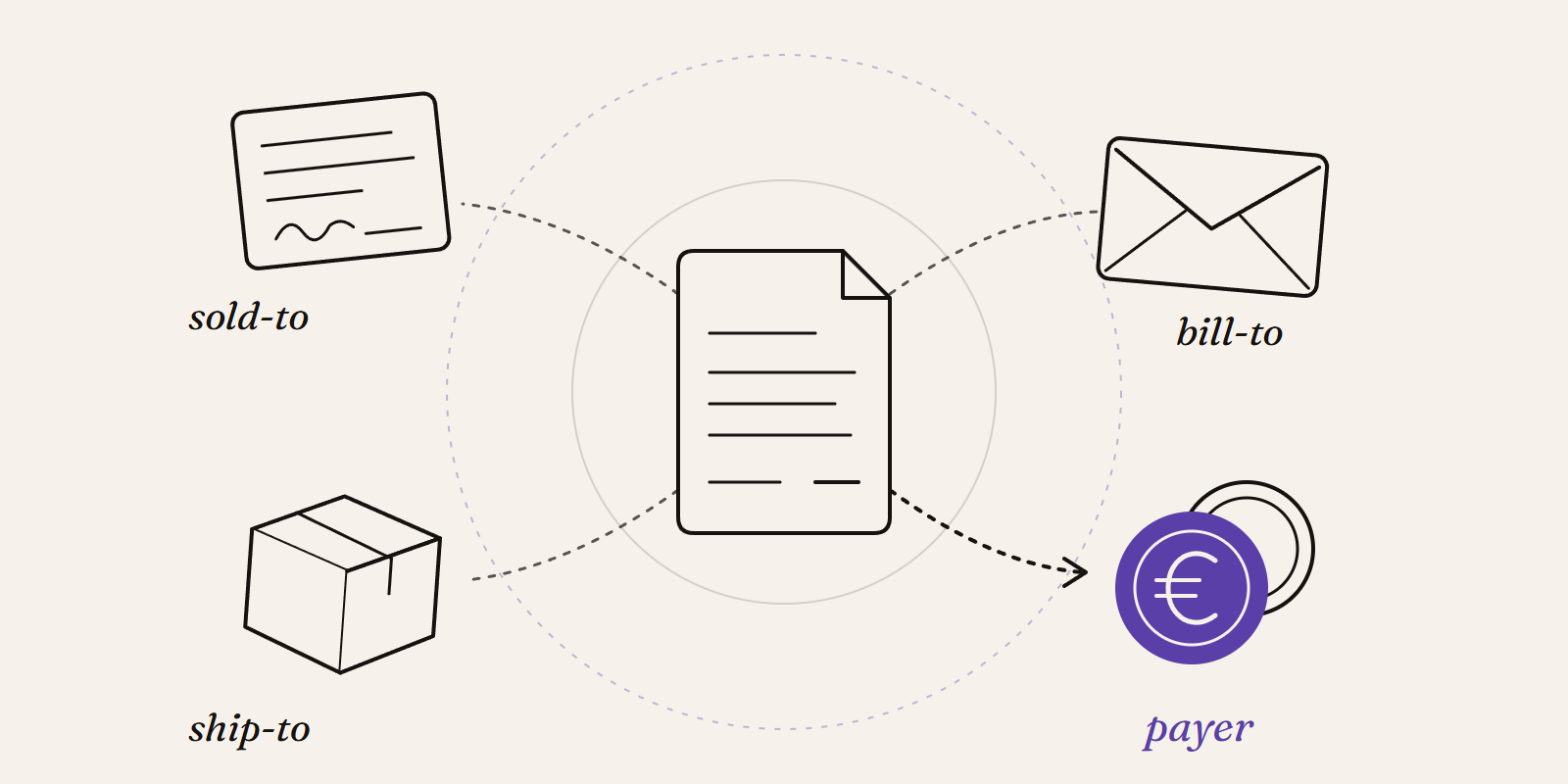
Sold-to, ship-to, bill-to and payer in SAP: who is actually your customer?
Sold-to, ship-to, bill-to and payer in SAP explained with a concrete example: who gets the invoice, whose account the receivable sits on, an...
New Data Panda connectors in July 2026
Seven new Data Panda connectors from July 2026, with practical applications for inspections, cash flow, planning, projects, equipment and si...