Supervised learning
What is supervised learning?
Supervised learning is a form of machine learning where a computer learns from examples that already include the right answer.
You feed the system a set of inputs together with the matching outputs. The model studies the link between the two, and once it has seen enough examples it can make predictions on new data it has never seen before.
A simple illustration: you show a model thousands of photos of cats and dogs, and for each photo you tell it which is which. After a while the system picks up the visual differences. Show it a new photo and it can say cat or dog with reasonable confidence.
Now hand that same model a photo of a giraffe and it will still try to call it a cat or a dog. The concept of giraffe never appeared in its training, so it has no slot for it. That is the biggest limit of supervised learning. It is excellent and efficient at the specific task it was trained on, but it stays narrowly tied to that task.
You will find supervised learning behind email spam filters, price predictions, face recognition, and credit risk scoring. The label "supervised" comes from the fact that you guide the system with the correct answers during training, like a teacher with an answer key.
It sits next to two siblings: unsupervised learning, where the model finds structure on its own, and reinforcement learning, where the model learns by trial and error.
Common use cases of supervised learning
Supervised learning shows up wherever you have plenty of historical examples with known outcomes. The most common patterns are:
Classification, putting something into a category.
Marking emails as spam or not spam.
Recognising what is in a photo (cat, dog, car).
Flagging whether a medical scan shows signs of disease.
Regression, estimating a numeric value.
Forecasting sales or revenue.
Estimating the price of a house.
Predicting product demand for next month.
Sentiment analysis, deciding if a piece of text is positive, negative or neutral.
Analysing customer reviews or social media posts.
Credit scoring and risk assessment.
Banks use models to predict whether a borrower is likely to repay a loan.
Fraud detection.
Spotting unusual transactions in banking or insurance data.
Product recommendations.
Suggesting items based on past behaviour or purchases.
The common thread: you need many examples that already carry the correct answer, so the model can learn the underlying logic and apply it on its own.
Strengths of supervised learning
Accurate results. With enough good training data, supervised models can be remarkably reliable.
Clear measurement. Because every example has a known answer, you can score the model against reality and see exactly how well it performs.
Broad applicability. The same approach handles image recognition, text classification, forecasting and many financial tasks.
Fast learning loop. The model gets continuous feedback on what is right or wrong, so training converges efficiently.
Limits of supervised learning
You need a lot of labelled data. Building training sets with correct answers takes time and money, and sometimes domain experts.
It only knows what it has seen. The model learns the patterns inside the training data, so genuinely new situations trip it up.
Risk of bias. If the training data carries human prejudice or sampling errors, the model inherits them.
Overfitting. A model can learn the training set so well that it memorises noise instead of patterns, and then performs poorly on real data.
Supervised learning works best when you have plenty of high-quality labelled examples. When data is scarce, incomplete, or shifts a lot over time, you usually need to combine it with other techniques.
Keywords
supervised learning
machine learning
unsupervised learning
reinforcement learning
classification
regression
ai
artificial intelligence
algorithms
prediction
From the blog.
More pieces from the field on the same topic.
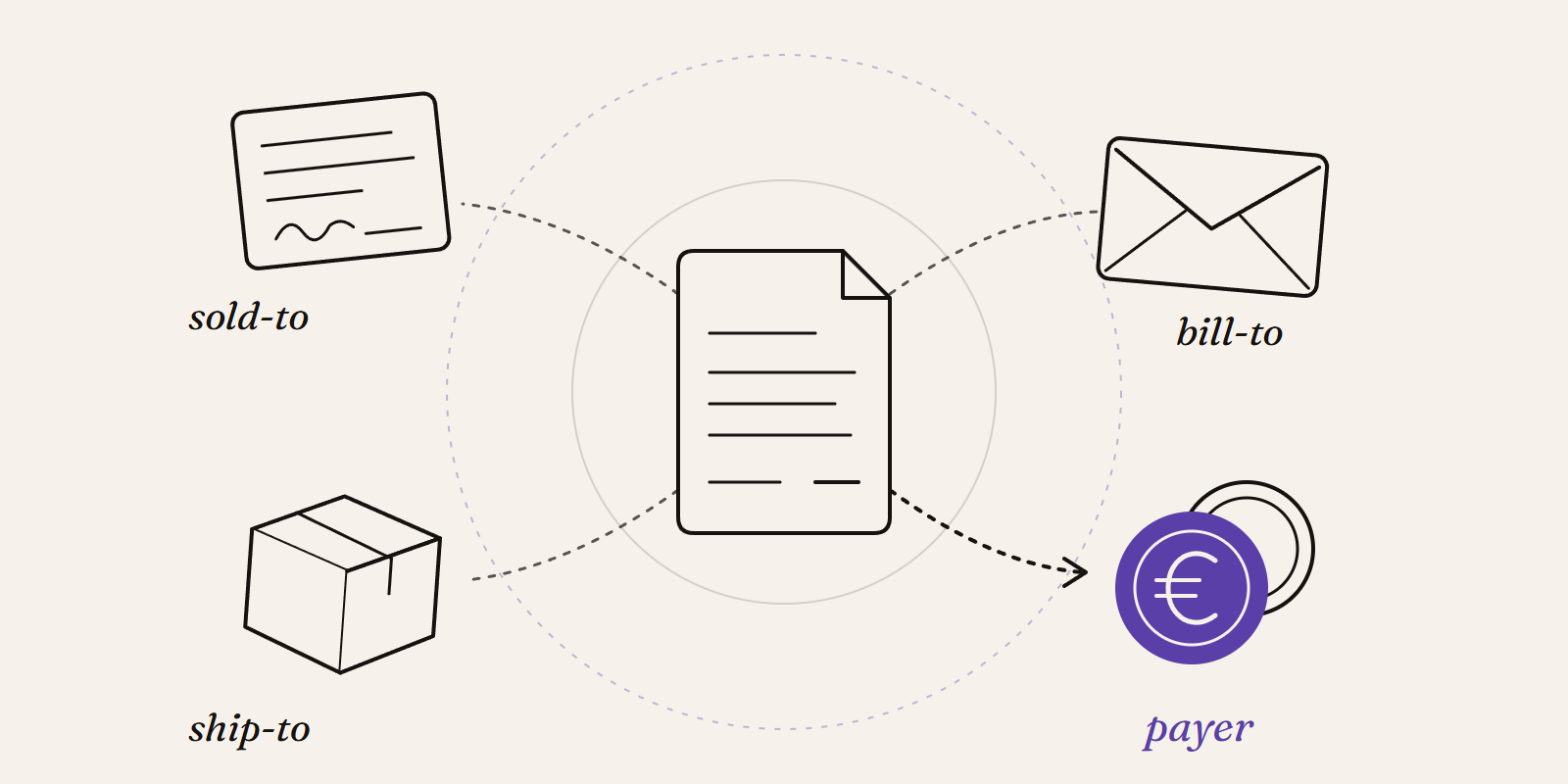
Sold-to, ship-to, bill-to and payer in SAP: who is actually your customer?
Sold-to, ship-to, bill-to and payer in SAP explained with a concrete example: who gets the invoice, whose account the receivable sits on, an...
New Data Panda connectors in August 2026
Seven new Data Panda connectors from August 2026: ECB rates, ProfitPlus Webshop, SAP S/4HANA, Exact Venice, OpusFlow, ABAX and Sprout Social...