Transformer architecture
What is the transformer architecture?
The transformer architecture is the backbone of almost every modern AI model. It shapes how a model makes sense of text, images, or sound by looking at the relationships between words or elements instead of reading them in order.
The core trick is that the model learns where to pay attention and where not to. That single shift made it dramatically better at understanding language than the systems that came before it.
A quick look back
The transformer was introduced in 2017 by researchers at Google in the paper Attention Is All You Need. Until then, most language models used recurrent networks that processed one word at a time. That was slow and struggled with long passages.
The transformer took a different route. Instead of stepping through a sentence word by word, it looks at all the words at once and uses attention to decide which ones matter to which. That turned out to be a huge leap in both speed and quality.
The well-known models that followed all built on the same foundation: BERT from Google and GPT from OpenAI, each with its own focus. BERT leaned into understanding text, GPT into generating it.
How a transformer actually works
A transformer is built from layers of neural networks that work together to understand meaning and produce new text.
The model uses a principle called attention. Rather than treating every word as equally important, it figures out which words form meaning together.
So in the sentence "The dog that barked ran away", the model can work out that "that" refers to "dog", even though other words sit between them.
Or take the word "bank". In "I sat on the bank of the river" it means a riverside. In "I work at a bank" it means a financial institution. The transformer picks up which meaning fits from the surrounding context.
To do all that, the process runs through a few clear steps:
Encoding the words
Each word is first turned into a sequence of numbers that represents its meaning.Adding position
Because the transformer does not read in order, every word also gets a position so the model knows what comes first and what comes last.Self-attention
This is where the model decides how much attention each word should pay to the others. That is how it learns relationships and context.Layers build understanding
Each layer revisits the relationships and refines the picture. With every layer, the model gains nuance and context.Encoder and decoder
The encoder makes sense of the input. The decoder uses that understanding to produce something new, such as a translation or an answer.
Why a transformer can process data so fast
The transformer works in parallel rather than sequentially. It processes all the words at the same time, not one after the other. That lets it take full advantage of modern GPUs and very large datasets.
It uses positional encoding to keep track of order, and attention calculations to share context across many layers in a smart way. The result is a model that is faster and sharper at picking up meaning.
How the transformer has evolved
Since 2017 the design has kept evolving. Some of the more important steps:
Better with long contexts. Techniques like Rotary Positional Embeddings and FlashAttention let models process thousands of words at once.
More efficient computation. New flavours of attention reduce the cost, such as Grouped-Query Attention or Mamba-style models.
Multimodal use. Transformers now also handle images, video, and speech. Vision Transformers and multimodal models read text and pictures side by side.
Faster output. Through speculative decoding, models can generate text without waiting word by word.
Newer variants like Mamba-2 and RWKV blend transformer ideas with linear-cost computation, which makes them stronger at long sequences while using less memory.
The focus has shifted from "bigger is better" to "smarter and more efficient". You see models that match the strongest of their generation but use less energy and train more quickly.
Keywords
transformer architecture
attention
self-attention
neural networks
deep learning
gpt
bert
large language models
ai
vision transformer
From the blog.
More pieces from the field on the same topic.
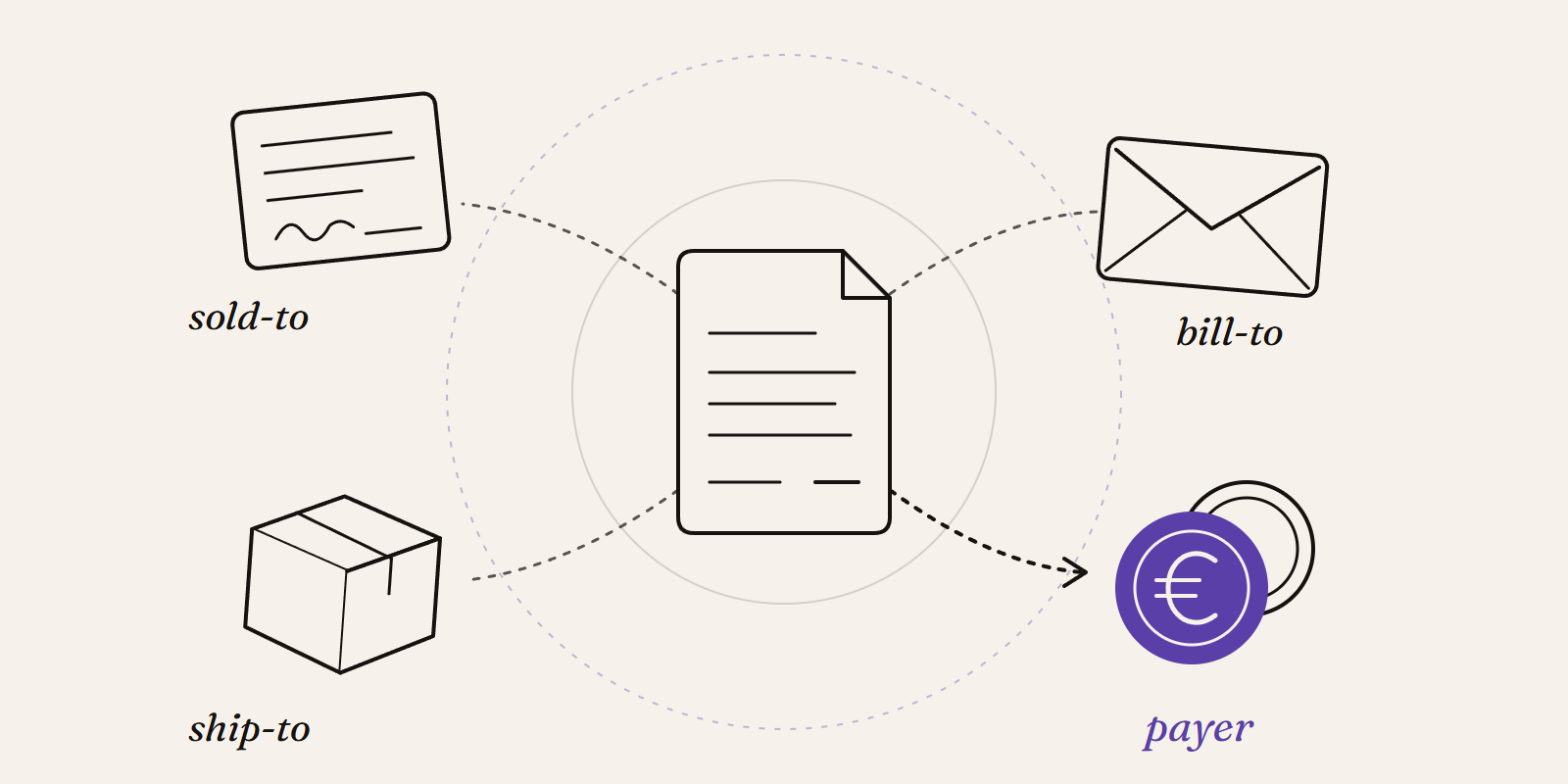
Sold-to, ship-to, bill-to and payer in SAP: who is actually your customer?
Sold-to, ship-to, bill-to and payer in SAP explained with a concrete example: who gets the invoice, whose account the receivable sits on, an...
New Data Panda connectors in August 2026
Seven new Data Panda connectors from August 2026: ECB rates, ProfitPlus Webshop, SAP S/4HANA, Exact Venice, OpusFlow, ABAX and Sprout Social...