CRM (Customer Relationship Management)
What is a CRM?
A CRM, short for Customer Relationship Management, is the system where a company manages its customer relationships. Contacts, companies, leads, opportunities, quotes, complaints, campaigns, emails, calls, and meeting notes all get a place.
Think of it as the shared memory of the commercial organisation. Without a CRM, customer knowledge sits in mailboxes, spreadsheets, notebooks, and individual salespeople's heads. When someone leaves, a piece of the customer relationship leaves with them.
Well-known CRM products include Salesforce, HubSpot, Microsoft Dynamics 365 Sales, Zoho CRM, Pipedrive, Odoo, and Teamleader. They differ in size and focus, but the core idea is the same: one place to manage the relationship from first contact to after-sales service.
Who uses a CRM?
Sales
Sales teams track leads, accounts, opportunities, quotes, expected close dates, probability, activity history, and next steps. The sales pipeline is usually the heart of the CRM.
Customer service
Support teams record tickets, complaints, questions, promises, and previous interactions. A person who answers the phone can see what happened last time instead of asking the customer to repeat the whole story.
Marketing
Marketing teams use CRM data for segmentation, campaigns, consent management, lead scoring, and follow-up. Who attended the webinar? Which customers bought product A but never product B? Which contacts may receive a newsletter?
Management
Managers use the CRM for pipeline reviews, forecasts, win rates, sales-cycle length, campaign performance, and customer retention signals.
The value comes from the combination. Three teams look at the same customer file instead of maintaining three separate lists.
CRM versus ERP
CRM and ERP are often mentioned together because they both describe business systems, but their centre of gravity is different.
A CRM manages the commercial relationship: prospects, contacts, opportunities, follow-up, service cases, and campaigns. An ERP manages operations and administration: orders, stock, delivery, production, invoicing, purchasing, accounting, and sometimes HR.
A sales opportunity and quote usually live in the CRM. Once the deal is won, the ERP often takes over for order fulfilment, inventory, delivery, invoice, and payment.
In practice the boundary is not perfectly clean. Many ERP suites contain CRM modules. Many CRM tools include quoting, invoicing, project tracking, or service features. Microsoft Dynamics 365, for example, includes both CRM-style apps and ERP-style apps. The real design question is not which system is the only truth? It is which system owns each field and how changes move between them.
CRM data versus accounting data
Accounting data records what actually happened: invoices, credit notes, payments, VAT, revenue, costs. It is controlled, audited, and usually corrected with care.
CRM data often records what might happen: open opportunities, expected amounts, probabilities, planned close dates, and next actions. Those numbers are useful, but they are not the same as booked revenue.
A CRM forecast is only as reliable as the sales discipline behind it. A deal that has been stuck in negotiation for six months should not quietly inflate next quarter's forecast. A close date that moves forward every month is not really a close date. Good CRM reporting always includes hygiene checks: stale opportunities, missing next steps, unrealistic probabilities, and deals without recent activity.
The CRM as a reporting source
For many companies, the CRM is one of the most important sources for business intelligence.
Sales pipeline and forecast
The classic metric is weighted pipeline: deal amount multiplied by probability. A 50,000 euro opportunity at 60 percent contributes 30,000 euro to the forecast. This is helpful, but only if the stages and probabilities are kept honest.
Customer segmentation
CRM data helps answer questions such as: which sectors convert best, which customers are becoming inactive, which campaign created qualified leads, which account manager owns which customers?
Customer 360 reporting
The CRM becomes more powerful when connected to ERP, webshop, support, and accounting data in a data warehouse. Then you can place pipeline, invoices, orders, tickets, margin, and payments next to each other.
This is also where the pain starts. The same customer may appear as Acme Ltd in the CRM, ACME Limited in accounting, and Acme Europe in ecommerce. Different names, different customer numbers, one real customer. That is a master data management and data quality problem, not a dashboard problem.
GDPR and consent in CRM data
A CRM is full of personal data: names, email addresses, phone numbers, job titles, notes, communication history, and sometimes sensitive context. In the EU, GDPR applies.
Two practical issues come up constantly.
Email marketing consent
Having someone's email address in the CRM does not automatically mean you can send them newsletters. Track what they consented to, when, through which channel, and for which type of communication.
Retention
Personal data should not stay in the CRM forever just because nobody cleans it. Define how long prospect, customer, and former-customer data is kept, and build review or deletion routines.
What to watch out for
Input discipline
Every CRM report depends on what people enter. Keep required fields limited, make updates easy, connect email and calendar where appropriate, and do not design a form nobody will fill in.
Duplicate records
Two salespeople create the same company. One uses the legal name, another uses the trade name. From that point on, history splits. Use clear creation rules, duplicate detection, and a stable identifier where possible.
Field ownership
If the billing address differs between CRM and ERP, which one wins? If a customer changes sector, who updates it? Field ownership matters more than people expect.
Integration from the start
A CRM island creates partial reports. Plan API access, warehouse extraction, identifiers, and change tracking early. It is much cheaper than trying to reconstruct history later.
Keywords
crm
customer relationship management
crm system
customer data
sales pipeline
erp
data warehouse
data quality
master data management
salesforce
hubspot
From the blog.
More pieces from the field on the same topic.
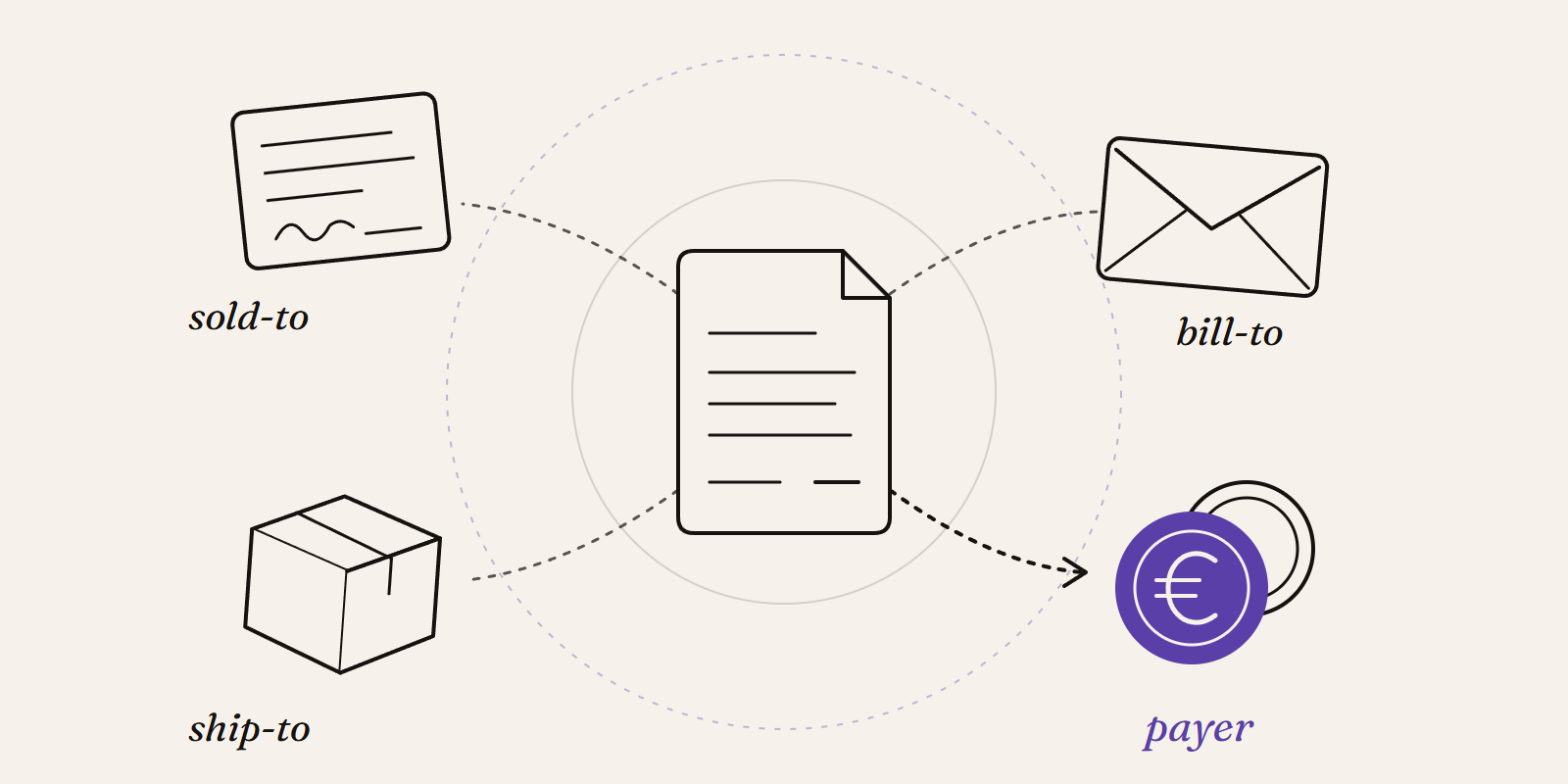
Sold-to, ship-to, bill-to and payer in SAP: who is actually your customer?
Sold-to, ship-to, bill-to and payer in SAP explained with a concrete example: who gets the invoice, whose account the receivable sits on, an...
New Data Panda connectors in August 2026
Seven new Data Panda connectors from August 2026: ECB rates, ProfitPlus Webshop, SAP S/4HANA, Exact Venice, OpusFlow, ABAX and Sprout Social...