Data domain
What is a data domain?
A data domain is a clearly bounded area of the business, together with the data that belongs to that area. Sales, finance, logistics, HR, product, and customer service can all be domains.
The word domain refers to a business area, not to a server, folder, or database schema. The sales domain may own customers, opportunities, quotes, and orders. The finance domain may own invoices, payments, cost centres, and the general ledger. The people who work in that area usually understand the meaning of the data better than a central team looking at the columns from a distance.
A good domain gives data a home. It says who understands the data, who may define it, who is responsible for its quality, and who users should ask when a number looks wrong.
Where the idea comes from
The language comes from domain-driven design, the software approach described by Eric Evans in 2003. In that world, a bounded context is a boundary where a business term has a stable meaning. Outside the boundary, the same word may mean something else.
That happens in data all the time. Sales may treat a customer as someone with a signed contract. Finance may treat a customer as a debtor with an open balance. Service may treat a customer as an installation address with an active support agreement. Same word, three useful meanings.
A data domain draws the boundary around one of those meanings and makes it explicit. That avoids pretending that one technical table can settle every business definition by itself.
Zhamak Dehghani brought the same thinking into data mesh: organise analytical data around business domains, give those domains ownership, and let them publish useful data products to the rest of the organisation.
A domain is not a database schema
This is the most common confusion. A database schema is a technical container for tables, views, functions, and permissions. A data domain is a business agreement: this area belongs to sales, these people own the definitions, these datasets matter, and this is what the terms mean.
The two can overlap, but they are not the same. Customer data may live in a CRM table, a lakehouse, a Power BI semantic model, and an accounting export. Those are several technical places, but the customer domain may still be one business domain.
The opposite also happens: one schema can mix sales, finance, and logistics data. That can be useful technically, but it does not answer who owns the meaning.
Short version: a schema says where data is stored. A domain says who owns the meaning and quality.
Domains in a data mesh
In a centralised platform, one data team often becomes the bottleneck for every definition, model, and extract. A data mesh changes the unit of ownership. Each domain becomes responsible for the data it knows best and publishes that data as a data product.
A data product should have a clear interface, owner, documentation, quality expectations, freshness expectations, and support route. The domain does not simply throw raw tables over the wall. It publishes data other teams can trust and reuse.
Data mesh literature often distinguishes domain roles:
Source-aligned domains publish facts close to where they arise, such as orders, invoices, shipments, or support tickets.
Consumer-aligned domains combine data for a specific analytical need, such as marketing attribution or finance planning.
Shared domains publish reusable datasets that several other domains depend on.
Microsoft Fabric uses similar language with Fabric domains: workspaces can be grouped under domains and subdomains so ownership, discovery, and governance follow the business structure instead of a flat technical list.
Ownership and stewardship
A domain without an owner is just a label. Each important data domain needs at least two responsibilities.
Data owner
The business person who can decide definitions, access, priorities, and quality targets. For a sales domain, this may be the sales manager. For finance, the CFO or finance lead.
Data steward
The operational person who keeps definitions documented, follows up quality issues, answers questions, and makes sure the data stays usable.
This is where domains connect to data governance. Governance sets organisation-wide rules. Domains are where those rules get a person, a backlog, and a decision-maker.
Master data management is related but different. MDM keeps shared concepts such as customer, product, supplier, or employee aligned across domains. Domains own their own data; MDM keeps the shared master records consistent where the business needs one version.
An SME example
Take a wholesaler with thirty employees. A simple domain split could look like this:
Sales
Owns customer data, quotes, orders, price agreements, and sales margin. The commercial lead is the owner.
Stock and logistics
Owns products, suppliers, stock levels, shipments, and delivery dates. The warehouse or operations lead is the owner.
Finance
Owns invoices, payments, ledger accounts, open balances, and cash-flow reporting. The office manager, accountant, or finance lead is the owner.
The benefit is clarity. If a revenue figure is wrong, you know which domain to involve. If product categories drift, stock and logistics owns the fix. As the company grows, domains can split further without redesigning the whole platform.
What to watch out for
Do not draw domains from the org chart alone
Departments change. Data domains should follow stable business concepts and processes.
Do not turn domains into silos
Domain ownership does not mean every team invents its own definitions. Shared concepts still need alignment through governance, contracts, and master data.
Keep technical and business boundaries visible
A Fabric workspace, warehouse schema, or folder can support a domain, but it should not silently become the definition of the domain.
Start with the domains people already recognise
Sales, finance, operations, product, and customer service are better starting points than an abstract enterprise taxonomy nobody uses.
Keywords
data domain
data mesh
data governance
data ownership
data steward
domain-driven design
bounded context
microsoft fabric
data product
From the blog.
More pieces from the field on the same topic.
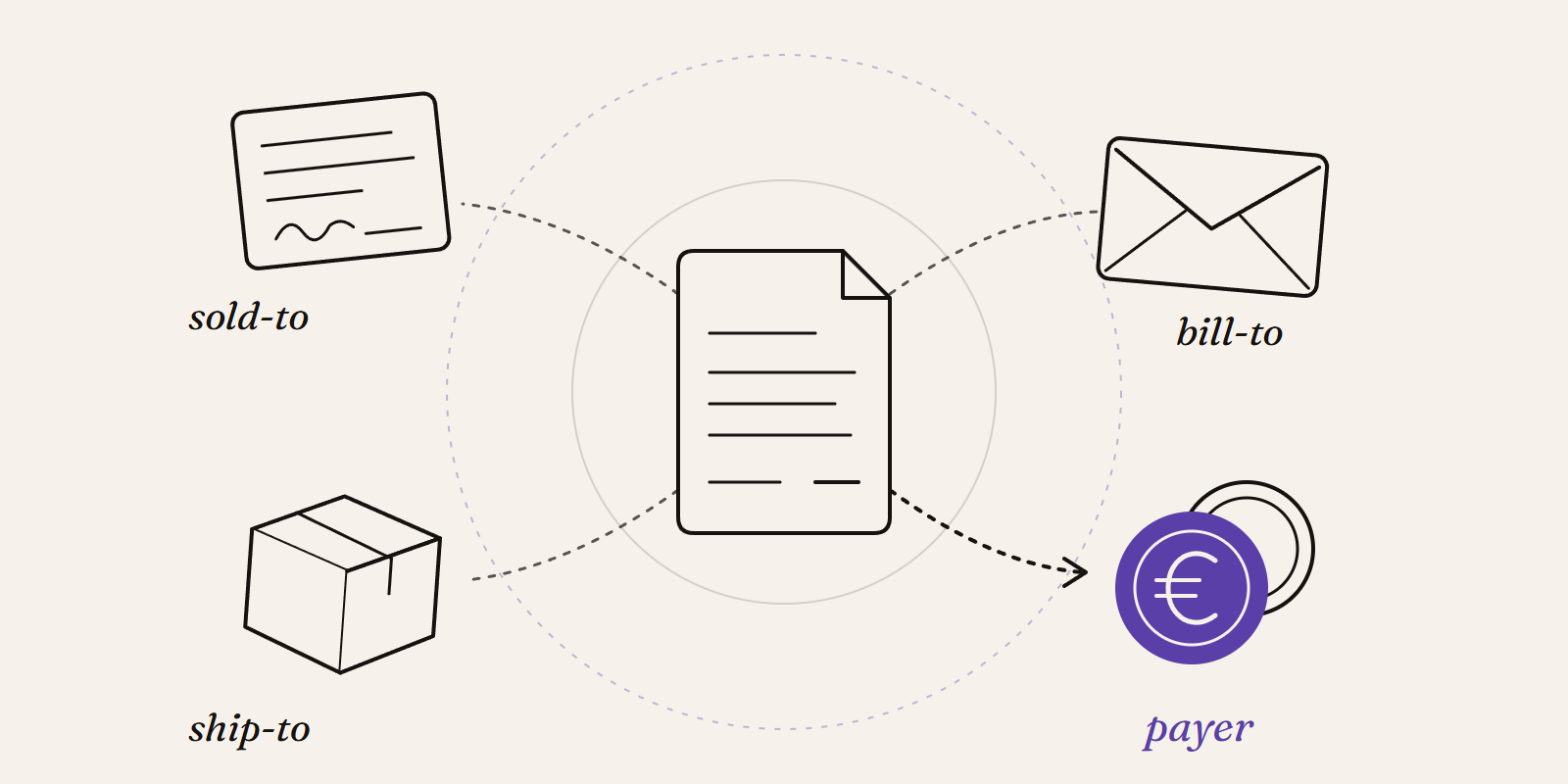
Sold-to, ship-to, bill-to and payer in SAP: who is actually your customer?
Sold-to, ship-to, bill-to and payer in SAP explained with a concrete example: who gets the invoice, whose account the receivable sits on, an...

Pretotyping Data Projects
Test data ideas fast with pretotyping. Learn how to validate concepts in days, avoid over-engineering, and build what truly adds value.