Golden record
What is a golden record?
A golden record is the resolved, best-value version of one business entity: a single customer, product, supplier, or employee, assembled from every system that holds data about it. When the same customer sits in your CRM, your ERP, and a support tool under three spellings and two addresses, the golden record is the version the rest of the business agrees to trust.
It is a result, not a system. A golden record is what master data management produces once it has worked out which records describe the same real-world thing and which value to keep for each field. The word golden describes agreement, not accuracy. It is the best version the current rules and source data can produce, and that can still be wrong.
How a golden record is built
Building one runs through three stages, usually inside an MDM platform.
Matching. The system compares records from different sources and decides which describe the same entity. This step is entity resolution: exact keys where they exist, fuzzy comparison of names, addresses, tax numbers, and email domains where they do not. Confident matches group automatically; borderline ones go to a data steward to confirm or reject.
Merging. Matched records form a cluster that stands for one entity. Nothing is discarded yet, and the cluster keeps a link back to every source record, which is what later lets you prove where each value came from.
Survivorship. For each field, a rule decides which source value wins. This is the step people underestimate, and it is where a golden record stops being simple deduplication and becomes a considered data quality decision.
Survivorship picks the winning value per field
Survivorship works attribute by attribute, not record by record. A weak deduplication tool keeps one whole surviving row and drops the rest. Real survivorship judges each field on its own and can take the email from one system, the billing address from another, and the company registration number from a third. The golden record it produces often matches none of the source records exactly. It is a composite.
The rule for each field is chosen deliberately. Common strategies include:
Source precedence. A named system always wins for a given field, for example finance owns the legal address and sales owns the account manager.
Most recent. The value with the latest update timestamp wins, useful for contact details that change often.
Most complete. The record with the fewest empty fields wins when no source is clearly more authoritative.
Trust score. Each source carries a reliability score per field, and the highest score wins.
Because every surviving value keeps a pointer to its source, you can open any field on the golden record and see which system it came from and when.
One golden record is usually a per-domain claim
"One golden record for the whole company" rarely survives contact with a real organisation. In practice the claim is scoped to one domain, and often to one use case.
Golden records are built per domain: customer, product, supplier, employee. Mastering customers tells you nothing about products, so each domain gets its own matching logic, rules, and steward. Different consumers can also need the same entity resolved differently. A marketing view of a customer may fold every brand and channel into one profile, while finance needs a record that ties cleanly to legal entities and VAT registration. Both are golden, and they disagree on purpose.
This is why some platforms compute the golden record as a view when it is requested rather than storing one frozen row: the resolved value depends on who is asking and which rules apply. Treating a golden record as the single source of truth is a fair goal, but the honest version is one trusted value per field, per domain, for a stated purpose.
Golden record versus system of record
These two get mixed up, but they answer different questions. A system of record is where a piece of data is authoritative: the application that owns it, where it is created and maintained, and where a correction has to be made to count. Your HR system is the system of record for an employee's start date; your ERP is usually the system of record for a supplier's payment terms.
A golden record is a resolved value, not a place. It is assembled from one or more systems of record and holds, per field, the value the business has agreed to act on. The system of record answers where data legitimately lives; the golden record answers what value you use given every copy you hold. A golden record often names a system of record as the winning source for a field, which is how the two fit together.
What to watch out for with golden records
Uncertain matches. Two customers with almost the same name are not always the same customer, and merging them creates a wrong record that is hard to unpick. Matching needs a confidence threshold and a review queue.
Conflicts should stay visible. If your CRM says a company's registration number is one value and your ERP says another, source precedence can pick a winner, but the disagreement is a data quality signal. Resolve it on the golden record and still log it, rather than letting the losing value vanish without trace.
Someone has to own the rules. Deciding that ERP wins for one field and CRM for another is a business call, not a technical one. A tool can apply the rule; it cannot decide who is right.
Keywords
golden record
master data management
entity resolution
data quality
deduplication
survivorship rules
system of record
single source of truth
data governance
master data
From the blog.
More pieces from the field on the same topic.
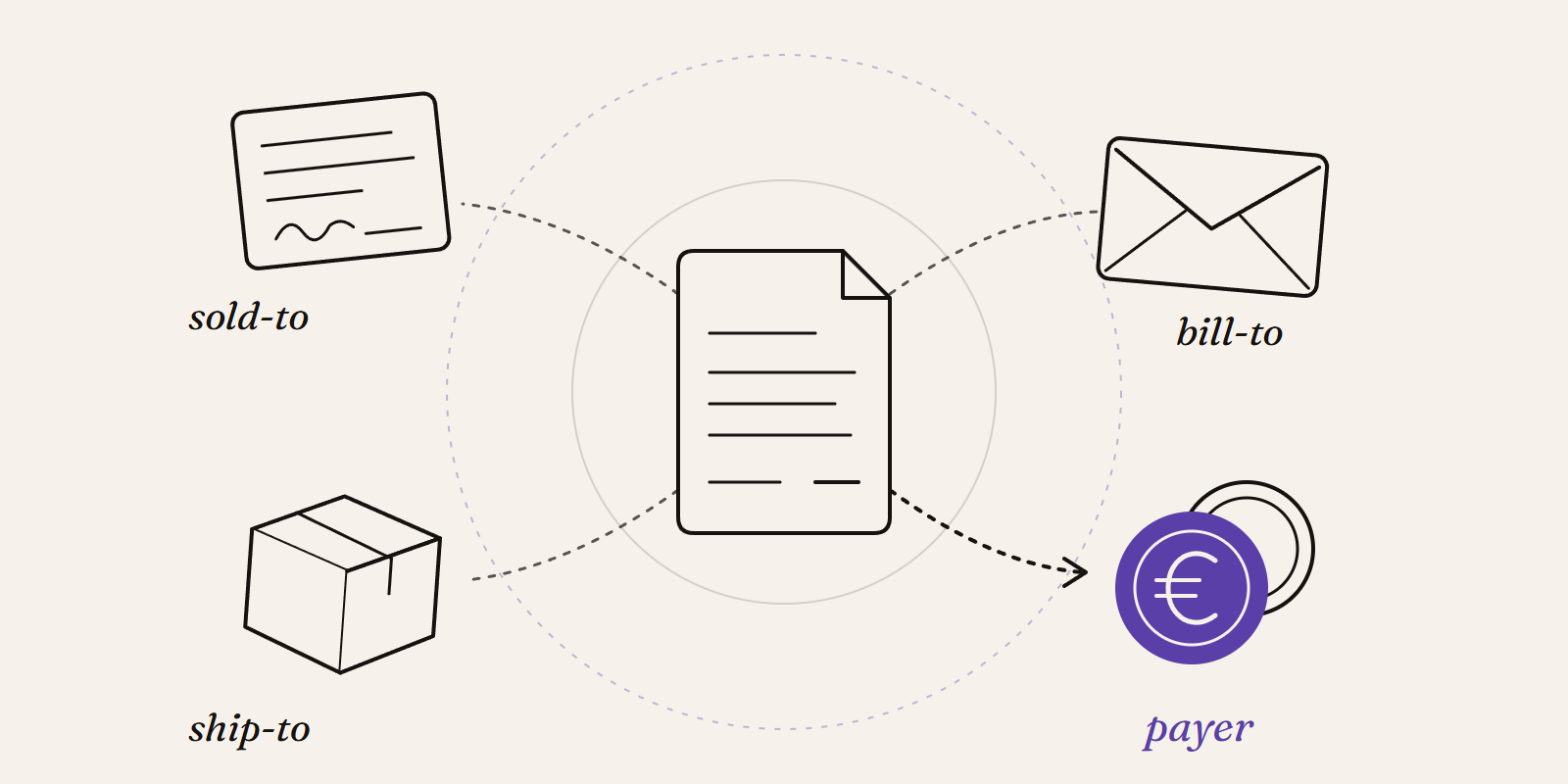
Sold-to, ship-to, bill-to and payer in SAP: who is actually your customer?
Sold-to, ship-to, bill-to and payer in SAP explained with a concrete example: who gets the invoice, whose account the receivable sits on, an...

How to create an event log for process mining
A step by step guide on how you can create an event log for process mining.