System of record
What is a system of record?
A system of record is the application your organisation treats as authoritative for a specific kind of data. When two systems disagree about a customer address, an invoice total, or an employee's start date, the system of record is the one you believe and the one you correct. Everything downstream copies from it.
The distinction that matters is authority, not storage. Naming a system of record answers who owns a piece of data and where it is allowed to change, not which database happens to hold a copy. Plenty of systems store a customer's phone number. Only one is meant to own it.
Authority is set per data domain
Because authority is granted per domain, one company runs many systems of record at once. The CRM is usually authoritative for sales contacts and account ownership. The ERP owns invoices, payment status, and the legal customer entity. The HR system owns employees, contract type, and department.
Authority can split within a single entity too. For the same customer, the CRM can be the system of record for the account manager and sales stage, while the ERP is the system of record for the billing address and outstanding balance. Writing this down field by field, rather than declaring that the CRM owns the customer, is what makes it usable.
System of record versus system of engagement
Geoffrey Moore drew this contrast in a 2011 paper for AIIM. A system of record is built around transactions and holds the trusted version of a record. A system of engagement is built around interactions: the portal, mobile app, chat tool, or collaboration space where people actually work. The engagement layer is where data gets captured and displayed. The record layer is where the agreed value lives. A support agent handles a conversation in a helpdesk tool, but the account's legal details still belong to the ERP.
How it differs from a golden record and a single source of truth
A golden record is a resolved value, not a system. Master data management builds it by matching duplicates across several systems of record and choosing the best value for each field, so the golden record is an output while the system of record is a designated source that feeds it.
A single source of truth is usually the place people go to read one agreed number, often a data warehouse or a dashboard. That is a consumption layer. A warehouse can be the single source of truth for reporting while the ERP stays the system of record for invoices. The warehouse harmonises and republishes, but the invoice is born in the ERP.
What to watch out for with systems of record
Give every system of record an owner. Without clear data ownership, authoritative is a label nobody maintains. The owner approves changes and settles conflicts.
Fix errors at the source. Correcting a wrong value only in a report means the next refresh overwrites your fix. Change it in the system of record instead.
Record the decision where people can find it. Systems of record belong in your data governance policy and data catalog, where the whole team can look them up.
Keywords
system of record
SoR
system of engagement
golden record
single source of truth
master data management
data governance
data ownership
CRM
ERP
data management
From the blog.
More pieces from the field on the same topic.
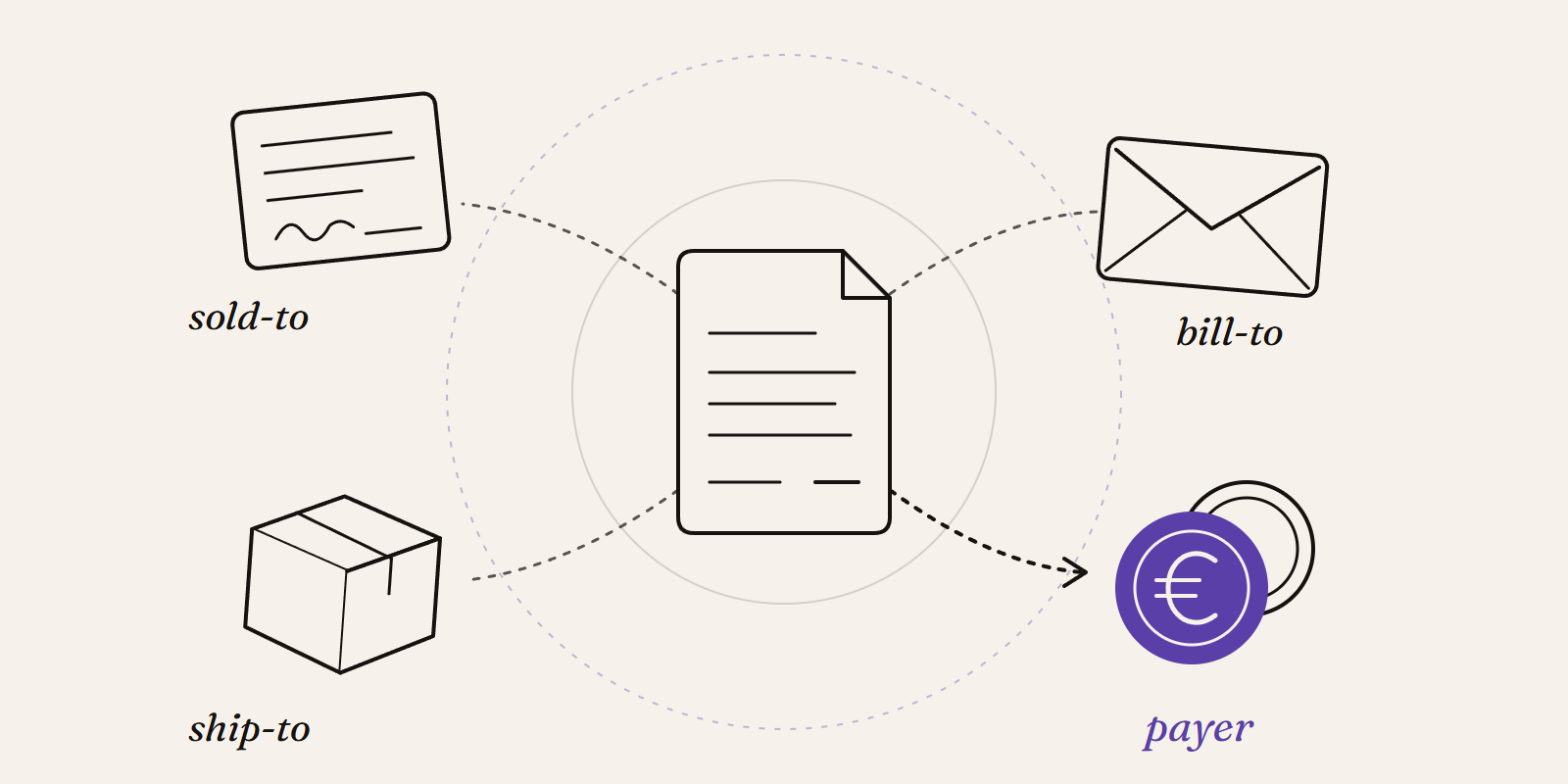
Sold-to, ship-to, bill-to and payer in SAP: who is actually your customer?
Sold-to, ship-to, bill-to and payer in SAP explained with a concrete example: who gets the invoice, whose account the receivable sits on, an...
New Data Panda connectors in August 2026
Seven new Data Panda connectors from August 2026: ECB rates, ProfitPlus Webshop, SAP S/4HANA, Exact Venice, OpusFlow, ABAX and Sprout Social...