Large Language Model (LLM)
What is a Large Language Model (LLM)?
A Large Language Model, or LLM, is a large AI model trained on enormous volumes of text to understand and generate language. It can answer questions, summarise content, translate, write code, or hold a conversation. LLMs are the engine powering tools like ChatGPT, Claude, Gemini, and Microsoft Copilot.
The word large isn't marketing. A modern LLM has billions to hundreds of billions of parameters. These are the internal "dials" that control how the model connects words and meanings. More parameters allow more nuance, but also require more compute and training data.
You can think of an LLM as a very smart prediction engine. Given a chunk of text, it estimates which word (or piece of a word) is most likely to come next, and builds its answer one token at a time. That sounds simple, but at sufficient scale the result feels surprisingly close to human language understanding.
How does an LLM work?
An LLM operates in three broad phases: pretraining, fine-tuning, and inference.
Pretraining
The model reads gigantic amounts of text, often hundreds of billions of words from books, websites, code, and articles. While reading, it continuously tries to predict the next word. Each miss nudges its parameters until it recognises patterns in language.
Fine-tuning
After pretraining, the model gets targeted training on smaller datasets. This teaches it to follow instructions politely, refuse sensitive requests, or specialise in a domain. Humans are often asked to rate model responses, a technique called Reinforcement Learning from Human Feedback (RLHF).
Inference
This is the moment you ask a question. The model splits your text into tokens (chunks of words), uses its transformer architecture to compute the most likely next token, and repeats that loop until the answer is complete.
Two technical terms keep coming back. Tokens are the units an LLM processes. A word like "database" may be split into several tokens. Embeddings are the numerical representations of those tokens the model uses to reason about relationships between words. The same technique powers vector databases in RAG applications.
Well-known LLMs
The market moves fast, but a handful of families dominate business contexts.
OpenAI's GPT models (GPT-4o, GPT-5) sit under ChatGPT and Microsoft Copilot. Also available via Azure OpenAI for companies that want to stay inside their Azure tenant.
Claude from Anthropic is known for long context windows and careful reasoning. Available through the Claude app, Amazon Bedrock, and Google Vertex.
Gemini from Google integrates deeply with Google Workspace and Vertex AI. Strong at multimodal tasks involving images and video.
Llama from Meta and Mistral are open-weight models you can self-host. Popular with organisations that don't want data leaving their infrastructure.
Beyond general-purpose models there are specialised variants for code (GitHub Copilot), for healthcare, or for a specific language or domain. For multilingual European contexts, models tuned on a local language such as Dutch, French, or German can outperform the largest generic model on native-language tasks.
When do you use an LLM?
Summarising and rewriting text
Shrinking meeting notes, rewriting emails in the right tone, turning a long contract into three bullet points.Question answering on your own data
Combined with RAG, an LLM answers questions about your own manuals, contracts, or product catalogue, with citations back to the source.Classification and extraction
Triaging incoming emails by intent, pulling amounts and dates out of invoices, scoring sentiment in customer feedback.Code generation and explanation
Developers use LLMs as a fast sparring partner for boilerplate, tests, or explaining unfamiliar code.Conversational interfaces
Chatbots, voicebots, and AI assistants that communicate naturally with customers or colleagues and route to the right team when needed.Search across company documentation
Traditional search engines return a list of links. An LLM with access to your documents returns a direct answer in business language.
Limits and things to watch out for
Hallucinations
An LLM can invent facts that sound convincing. For critical use cases you always need grounding through documents or tools, plus some form of verification by a human or a hard rule.
Outdated knowledge
The model only knows what was in its training data. Fresh information must be fed in through RAG or a live data source such as an API or database.
Context window
Each model has a limit on how much text it can process at once. For large documents you need to split or filter inputs smartly before sending them to the model.
Cost and speed
Larger models are slower and more expensive. In production it's often a trade-off: small and fast for simple triage, large and capable for complex work. Many applications combine both.
Privacy and data leakage
Whatever you send to a public LLM may be processed or stored elsewhere. For sensitive business data, work inside a ring-fenced environment such as Azure OpenAI, Amazon Bedrock, or a self-hosted open model.
LLMs in a business context
An LLM isn't something you drop into a business on its own. The real value comes from combining it with other building blocks:
Data integration: without access to your own documents and systems, output stays generic.
RAG: brings in current, business-specific knowledge.
Tool calling: lets the model take actions, such as creating a ticket or running a calculation via an API.
Human-in-the-loop: keeps humans in charge of decisions with real impact.
Monitoring and evaluation: tracks performance and errors over time. Without measurement you can't tell whether your model is getting better or worse.
For most organisations the real question isn't which LLM is smartest, but which LLM fits their data policy, their budget, and their existing stack. A smaller open model close to the data often beats the largest model in a public cloud in practical use.
Keywords
large language model
llm
generative ai
genai
transformer
embeddings
chatgpt
artificial intelligence
neural network
ai
rag
From the blog.
More pieces from the field on the same topic.
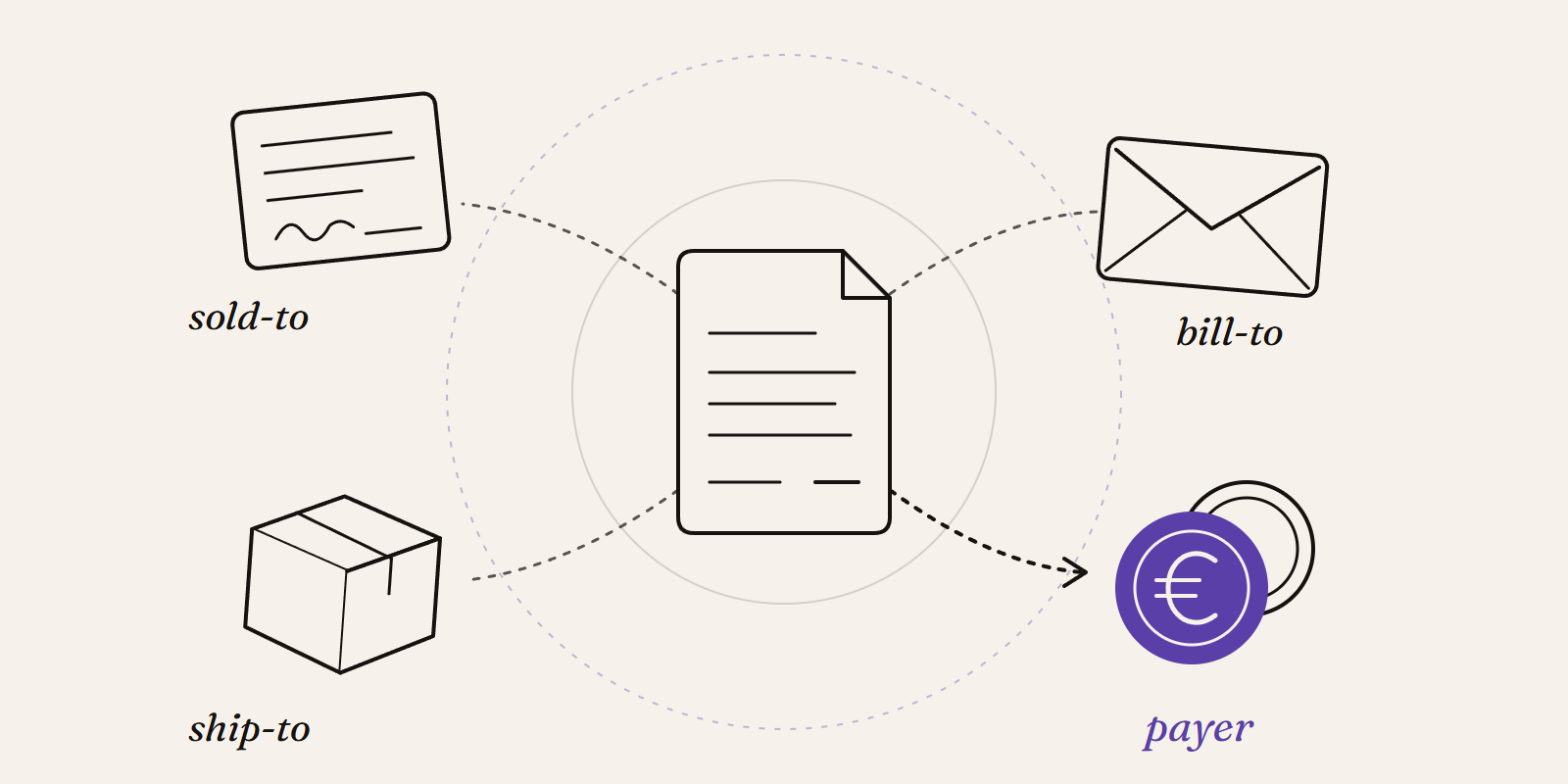
Sold-to, ship-to, bill-to and payer in SAP: who is actually your customer?
Sold-to, ship-to, bill-to and payer in SAP explained with a concrete example: who gets the invoice, whose account the receivable sits on, an...
New Data Panda connectors in August 2026
Seven new Data Panda connectors from August 2026: ECB rates, ProfitPlus Webshop, SAP S/4HANA, Exact Venice, OpusFlow, ABAX and Sprout Social...