Machine learning
What is machine learning?
Machine learning is software that learns patterns from examples instead of following rules that someone wrote by hand. You give the system data, and it works out the relationship between the input and the answer you care about.
A spam filter is the classic example. A rule-based filter blocks messages with words such as free or winner. That works until spammers change their wording. A machine learning filter learns from thousands of messages that people marked as spam or safe mail. It can pick up combinations of signals that would be painful to maintain as rules.
Machine learning is part of artificial intelligence. It sits behind recommendations, fraud detection, traffic predictions, demand forecasting, image recognition, and many of the systems that now get grouped under AI.
How a model learns
Training starts with examples. For a house-price model, each example might contain the size, location, number of rooms, building year, and the final sale price. The model makes a prediction, compares it with the real answer, and adjusts its internal parameters to reduce the error.
That loop runs many times. When training is done, the model becomes a function that can take a new house and estimate a price. Using the trained model on new input is called inference.
The test step matters as much as the training step. If you judge a model on the same examples it learned from, it can look better than it is. Teams hold back a test set and check whether the model works on cases it has never seen. A model that performs well on training data and poorly on test data is overfitting: it memorised the examples instead of learning the pattern.
The main learning styles
Supervised learning learns from labelled examples, where the right answer is already known. That covers classification, such as spam or safe mail, and regression, such as predicting revenue or delivery time.
Unsupervised learning receives data without labels and looks for structure. It can cluster customers with similar buying behaviour or find unusual records that deserve attention.
Reinforcement learning learns by trying actions and receiving rewards or penalties. It is common in robotics, games, route optimisation, and simulation-heavy work.
Deep learning is a family inside machine learning that uses neural networks with many layers. It is especially strong for text, images, speech, and other data where the useful pattern is hard to define by hand.
Machine learning, classic software, and generative AI
Classic software is best when the rules are known and stable. VAT, discounts, payroll rules, and access checks should be coded directly. A machine learning model is useful when the rule is too complex, too fuzzy, or too changeable to write down cleanly.
Machine learning also differs from generative AI in everyday use. A classic machine learning model usually predicts a number, a category, a risk score, or the next likely event. A generative AI model creates text, images, code, audio, or other content. Generative AI is built with machine learning, but the product experience is different.
Where companies use machine learning
Demand forecasting. Predict sales from history, seasonality, promotions, and stock movements.
Anomaly detection. Flag unusual transactions, invoices, sensor readings, or login behaviour.
Churn prediction. Spot customers whose behaviour looks like earlier customers who left.
Predictive maintenance. Use sensor data and failure history to plan maintenance before downtime hits.
Document and image processing. Recognise invoices, classify support tickets, read scans, or extract fields from forms.
The practical test is simple: do you have repeated decisions, historical examples, and enough feedback to tell whether the prediction was right?
What you need before starting
History. A model learns from the past. If you want to predict churn, you need examples of customers who stayed and customers who left.
Labels and quality. For supervised learning, each example needs a trustworthy answer. Duplicate records, missing fields, and wrong labels are learned along with the genuine pattern.
An owner after launch. A model does not stay sharp by itself. Prices change, customers change, fraud patterns change, and product ranges change. Monitoring, retraining, and release control are part of MLOps.
What to watch out for with machine learning
Bias in the training data. A model learns from the past, including the unfair or accidental patterns inside it. Check who the model performs badly for, alongside the average score.
Model drift. A demand model trained before a price change or a store move can become stale quickly. Track model performance against real outcomes.
Probability, not certainty. A model usually says that something is more or less likely. Use the prediction as input to a decision. For sensitive areas such as credit, hiring, health, or legal work, keep human review in the process.
Keywords
machine learning
ML
supervised learning
unsupervised learning
reinforcement learning
inference
model drift
MLOps
anomaly detection
generative AI
artificial intelligence
From the blog.
More pieces from the field on the same topic.
How to create an event log for process mining
A step by step guide on how you can create an event log for process mining.
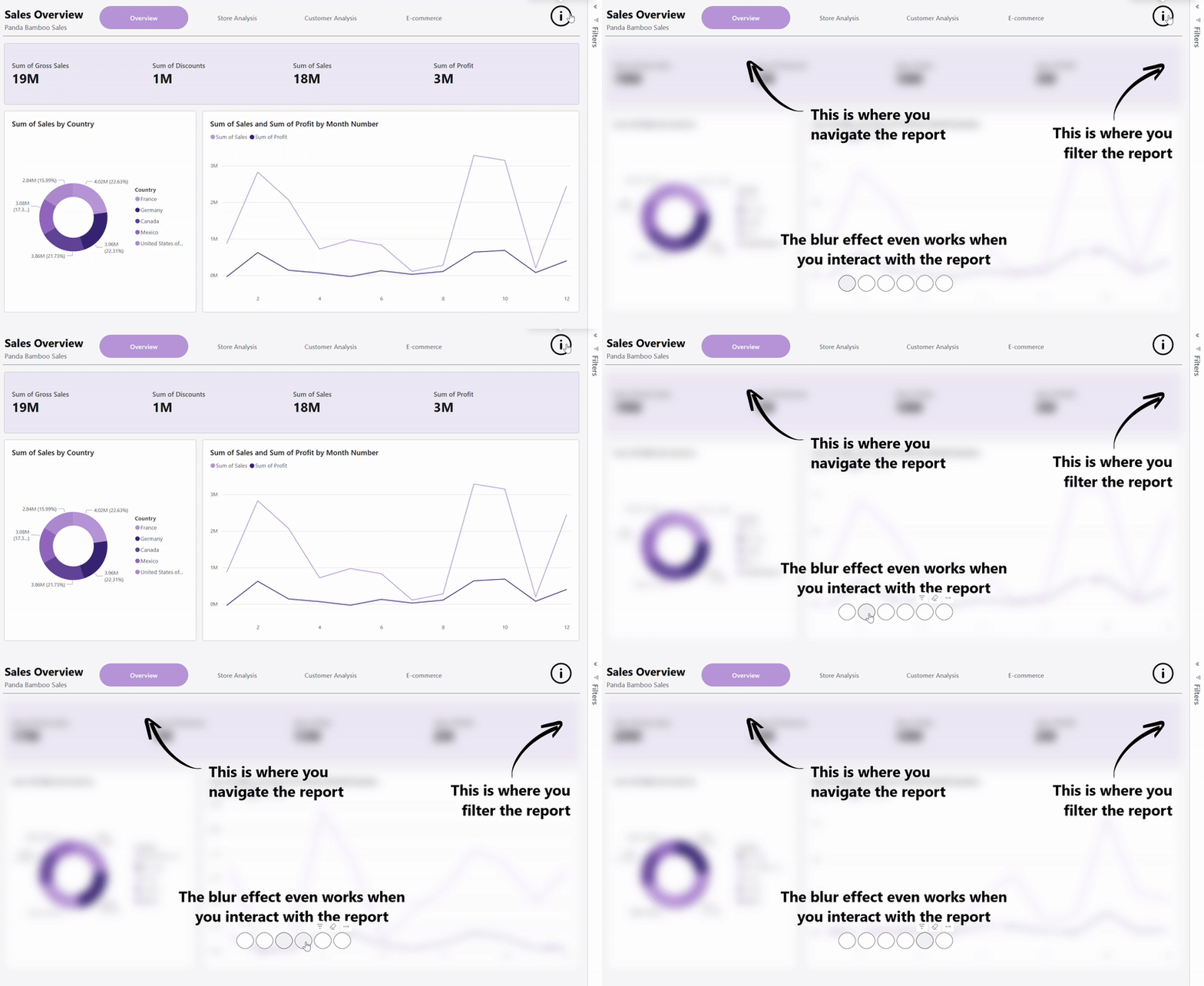
How to Blur Your Power BI Reports (and Why You Should Try It)
Learn how to add a blur effect to your Power BI reports using a simple HTML trick. Guide your users’ attention, create interactive overlays,...